Original source: Adobe Marketo Engage User Groups
This article is an editorial summary and interpretation of that content. The ideas belong to the original authors; the selection and writing are by Marketo Ops Radar.
This video from Adobe Marketo Engage User Groups covered a lot of ground. 5 segments stood out as worth your time. Everything below links directly to the timestamp in the original video.
If you're planning to introduce AI agents into your instance, the navigability of your folder structure and template library is no longer just a housekeeping concern — it's a functional prerequisite. The patterns discussed here give you a concrete starting point without requiring a full remediation before you can move.
How to Make a Marketo Instance Navigable by AI Agents: REST API, Deduplication at Scale, and Munchkin Deployment
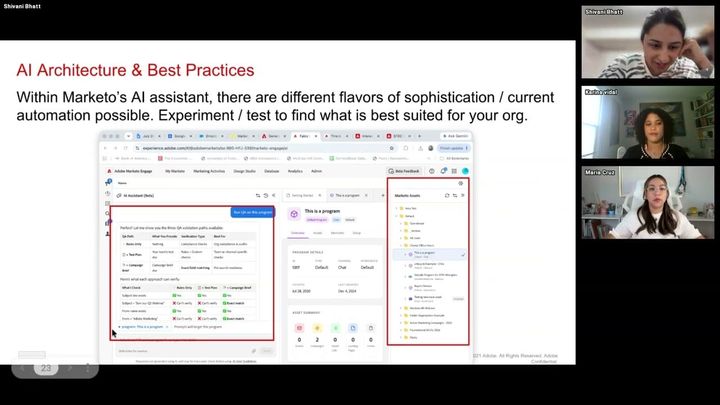
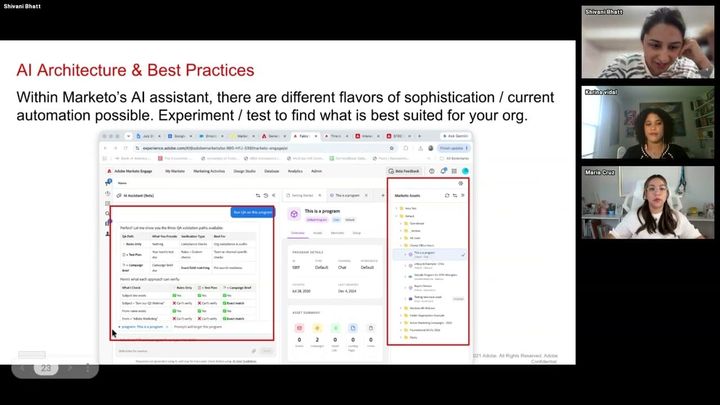
A recurring pattern in AI-ready Marketo deployments is that the instance must be navigable by a new human operator before it can be navigable by an AI agent. Practitioners discussed how AI agents interact with Marketo primarily through the REST API, which means folder structures, naming conventions, program descriptions, and template organization all function as navigation signals — not just organizational preferences. The practical implication is that ambiguity that a human can resolve through context or muscle memory becomes a hard blocker for an agent.
On deduplication, the discussion surfaced a scalable pattern: rather than periodic mass-dedup exercises, teams can build continuous automated rules that catch duplicates as they emerge, with AI-assisted merging applied at scale based on defined criteria. This shifts deduplication from a one-time remediation project to an ongoing operational process. For Munchkin tracking, a concrete deployment recommendation emerged: use a tag manager rather than hardcoding the snippet, which simplifies governance and reduces the risk of tracking gaps going undetected.
A practical interim strategy was also shared for teams with messy instances who face pressure to move quickly: rather than attempting a full cleanup before introducing AI, isolate a well-structured area of the instance and point AI tooling there first. This allows teams to demonstrate AI value without waiting for full remediation, while the broader cleanup continues in parallel.
"If a human can't navigate your instance, AI definitely won't be able to either."
Why AI Scoring Models Fail Without Integration Mapping: A Concrete Lesson from a Closed-Won Date Mistake
A cautionary pattern emerged from work on an AI lead scoring model: when data sources are not explicitly documented and communicated to the model, AI will identify statistically valid but operationally nonsensical predictors. In the example shared, the model identified closed-won date as the strongest MQL-to-SQL predictor — because the field was present in the dataset and correlated perfectly with conversion. Without context about where that field comes from and when it is populated, the model cannot distinguish a meaningful leading indicator from a data artifact. The lesson is that AI does not infer data provenance; it must be told.
The practical recommendation for documenting integrations was deliberately low-tech: a spreadsheet mapping field labels, REST API names, and data sources is sufficient for most instances. For more complex environments with multiple overlapping sources for the same field, a visual data flow diagram adds value, but the baseline documentation does not need to be elaborate. The key output is a reference document that can be uploaded as context whenever AI is engaged on a data-related task.
A lightweight workaround for capturing offline engagement data without a CDP was also discussed: an internal form completed by field reps or BDRs during or after in-person conversations, which writes directly to a Marketo program and syncs to the CRM. This approach keeps high-value engagement data in the system of record without requiring sales to change their workflow significantly, and ensures that data is available as AI scoring input rather than remaining siloed in spreadsheets.
"If you don't know where and when your data comes from, AI won't know it either."
Empty Fields Cost Real Money: The Token-Cost Case for Marketo Data Model Cleanup
A framing that recontextualizes routine data cleanup work: when AI is used programmatically at scale — processing leads through a model rather than through an interactive chat session — every field passed to the model consumes tokens and incurs cost. Empty, deprecated, or junk fields that remain in the data schema are not neutral; they add token overhead on every request without contributing signal. At volume, this cost compounds significantly. The implication is that data model hygiene has a direct and quantifiable operational cost in AI-enabled instances, not just a quality impact.
The recommended approach to field-level documentation for AI contexts is deliberately concise: short descriptions that identify what the field contains, where it comes from, and when to use it. The reasoning is that blank fields are more costly than verbose descriptions — a description at least returns value in the form of better model context — but over-explanation adds cost without proportional benefit. Practitioners were advised to prioritize writing any description over writing a perfect one, given how few Marketo instances currently use field descriptions at all.
On deduplication, the discussion reinforced that duplicate records fragment the engagement history of a single person across multiple records, making it impossible for AI to construct a coherent behavioral profile. The recommended pattern is continuous deduplication — smart campaigns that flag duplicates as they are created, combined with AI-assisted merging based on defined rules — rather than periodic mass remediation. Fields that are known to be unreliable should be explicitly flagged or blocked and documented, so AI is not trained on or asked to interpret data that practitioners already know is suspect.
"Clean field definitions are going to be the foundation of reliable AI output."
Treating Marketo Architecture as AI Infrastructure: Templates, Folder Logic, and Process Documentation as Machine-Readable Inputs
A recurring theme across the session crystallized into an explicit principle: Marketo instance architecture — folder structures, naming conventions, template organization, program descriptions — functions as infrastructure for AI agents in the same way it functions as infrastructure for human operators. The difference is that humans can tolerate ambiguity and infer intent from partial signals, while AI agents cannot. This reframes familiar MOps best practices as a technical prerequisite for AI readiness rather than optional organizational discipline.
The discussion surfaced a forward-looking recommendation: document operational processes — such as how to send a promotional email, which campaigns to update, and which fields to populate — in step-by-step format, and where possible, map those steps to their API equivalents. This creates documentation that can serve both as a human runbook and as a structured input for future agent automation, reducing the gap between current manual workflows and potential agent-driven execution.
For teams managing instances that are not fully structured, a practical interim approach was recommended: rather than attempting full remediation before introducing AI, create a designated clean area within the instance — properly named, templated, and described — and scope initial AI tooling to that area. This allows teams to demonstrate value and build familiarity with AI-assisted workflows while broader cleanup proceeds in parallel. The principle underlying all of this is that descriptions on folders, templates, and programs serve as README files for AI agents — and an instance without them is effectively undocumented from the agent's perspective.
"If a human can't navigate your instance, AI definitely won't be able to — so if you need to move quickly, set aside one clean area and point AI there first."
Using AI to Classify Raw Job Titles Into Personas — and Why Field Consolidation Is the Prerequisite
A practical AI use case was presented for a problem that most Marketo practitioners encounter: job title data is freeform, inconsistent, and difficult to segment reliably. AI can categorize raw job title values into defined persona buckets at scale, removing the need for manual segment maintenance and handling the variability that makes rule-based approaches brittle. The use case is well-suited to AI because it is a classification task with clear criteria and tolerates imperfect inputs better than rule-based logic does.
However, the use case surfaces a prerequisite that is easy to overlook: the AI can only classify job title data that exists and is consistently captured. If the instance has multiple overlapping job title fields — populated from different sources with no clear source of truth — the classification output will be unreliable regardless of model quality. The same applies if the field is not reliably captured on forms or synced from the CRM. Consolidating to a single authoritative job title field, with clear documentation of its source and population logic, is the necessary first step before the AI use case delivers value.
This example illustrates a broader pattern discussed across the session: AI use cases in Marketo are bounded by the quality and structure of the underlying data, not by the capability of the model. Sophisticated AI tooling applied to fragmented or undocumented data produces confidently wrong outputs rather than obvious errors — which makes the failure mode harder to detect than a straightforward data quality issue.
"If you don't have a reliable field for job title, AI will segment something that means nothing in the end of the day."
Also mentioned in this video
Summarised from Adobe Marketo Engage User Groups · 41:48. All credit belongs to the original creators. Streamed.News summarises publicly available video content.