Campaign Operations
A curated anthology of the best moments on this topic — drawn from across the full video library, ranked by editorial relevance, with direct links to the exact timestamp in every source session.

Form localization in Marketo is usually solved by duplicating assets per language — but the JavaScript API approach demonstrated here collapses that into a single form with runtime behavior. If your team is managing compliance checkboxes across multiple regulatory regimes, this pattern is worth examining closely.
Watch full session ↗Beyond Dynamic Content: Using Marketo's JavaScript API to Localize Forms and Conditionally Control Compliance Checkboxes by CountryA practitioner outlined a decision framework for choosing between tokens and dynamic content in global campaigns, then demonstrated a less commonly used approach: JavaScript API on Marketo landing pages to auto-translate form field labels and conditionally pre-check or uncheck co
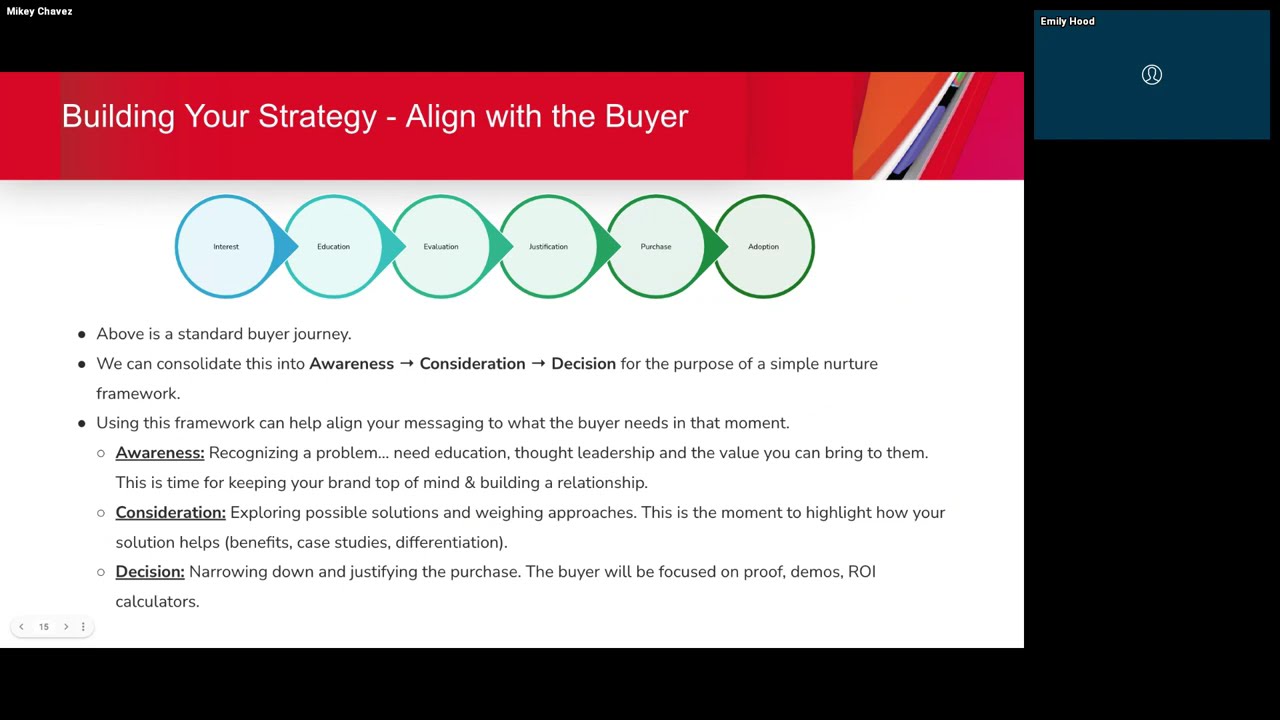
If your nurture assignment logic is scattered across dozens of programs, this architecture gives you a single source of truth without sacrificing flexibility. The choice-step ordering pattern alone is worth the refactor.
Watch full session ↗One Control Program to Rule Them All: A Centralized Nurture Assignment ArchitectureA practitioner shared a centralized default program architecture designed to replace the sprawling, program-by-program add logic that makes multi-nurture Marketo instances difficult to manage. The approach uses three custom string fields — tracking current nurture assignment, cur

If your nurture architecture is sprawling into six-plus streams and per-program entry campaigns that quietly conflict with each other, the patterns discussed here offer a more maintainable structural approach. The nested program and nurture router techniques in particular solve problems that most practitioners only recognise after they've already built the messy version.
Watch full session ↗Advanced Nurture Architecture: Nested Programs, Multi-Region Streams, and Centralised Router LogicA practitioner walked through a layered set of engagement program patterns that go well beyond basic stream setup. The standout technique involves nesting default programs inside nurture streams rather than using bare email assets — enabling send-level filtering, content swaps, a
One Registration Page for All Recurring Webinars: A JavaScript and Program-Naming Token ApproachA practitioner presented a technique for building a single static Marketo landing page that serves as a permanent registration page for recurring webinar events. The core mechanic involves encoding event metadata — timestamps, title, region — into a program naming convention, the
Three Non-Obvious Email Program Tips: Batch Status Cascading, Nested Reporting, and Modular Velocity ScriptsA presenter shared three email program patterns that address common scalability and maintainability problems. The first involves replacing trigger-based status updates with a scheduled batch campaign that cascades statuses through priority-ordered flow steps — most important stat
Token-Mapped Intake Briefs and the Path Toward Automated Program PopulationA marketing operations practitioner described a structured briefing process built around Marketo's token architecture. The current-state approach uses a Word document template in which every stakeholder-facing field maps directly to a program token. Required fields are colour-cod
Over-Engineered QA Caused More Errors Than It Prevented — Here's the Simpler Model That Fixed ItA practitioner shared a before-and-after case study on QA process redesign within an enterprise marketing automation team. The original process distributed responsibility across three team members per program — builder, initial reviewer, and final reviewer — with handoffs at each
How Automated Intake Avoids Token Overwriting: One Submission, One Clone, One ProgramA Q&A exchange following the briefing intake presentation clarified a key implementation detail: when multiple briefs are submitted by the same stakeholder group, token overwriting is avoided because the integration does not write back to a shared template. Instead, each form sub
If your dynamic content is misbehaving, the segmentation logic — particularly default segment coverage and title filter completeness — is usually where the problem lives. This walkthrough makes the mechanics explicit.
Watch full session ↗Snippets as Centrally Managed Content Blocks: The Approval Workflow Gotcha Practitioners MissA practitioner demonstrated how Marketo snippets function as reusable content blocks that can be embedded in multiple emails and landing pages — with any update to the snippet propagating automatically across all assets using it. The key operational advantage is centralized contr

The handraiser alerting pattern here is immediately deployable, but the duplicate-trigger constraint warning is the kind of hard-won operational detail that doesn't appear in product documentation — and the damage it prevents is real.
Watch full session ↗Build a Repeatable Marketo Program Architecture for Chat Handraisers — Including a Critical Trigger GotchaA practitioner outlined a reusable Marketo program structure for chat deployments, recommending one program per dialogue or conversational flow to enable granular reporting from the start. The architecture uses three progressive smart campaigns: one to capture any dialogue intera
Dialogues vs. Conversational Flows: Setup Differences That Affect How You Instrument Marketo ProgramsA presenter walked through the two distinct interaction models in Dynamic Chat — traditional dialogues that appear as a persistent chat widget, and conversational flows that are embedded directly into Marketo forms and triggered as a popup on form submission. While the stream des
Sales Agent Setup, Routing Rules, and the Meeting Fallback Pattern That Protects Handraiser ConversionA practitioner covered the operational requirements for enabling sales agents in Dynamic Chat, including the detail that agent provisioning happens through the Adobe admin console rather than through Marketo or the chat tool itself — a setup step that can catch teams off guard. A
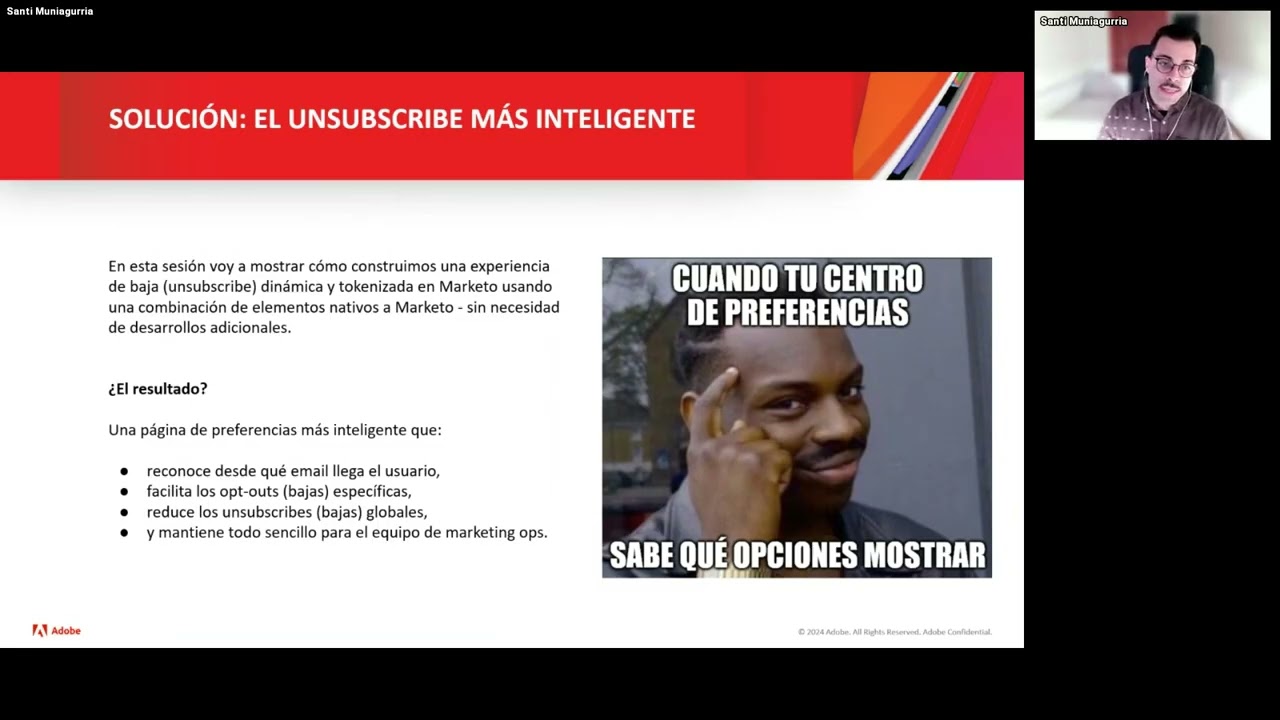
If your team regularly ships emails with misconfigured footer links, this folder-token pattern addresses the root cause without requiring any process enforcement. The URL parameter mechanism for forcing dynamic content is also worth testing in your own instance — it opens up personalization use cases well beyond preference management.
Watch full session ↗A Native Marketo Pattern for Contextual Unsubscribes Using URL Parameters to Force Dynamic ContentA practitioner demonstrated a 'smart unsubscribe' system built entirely with native Marketo functionality — no custom development required. The architecture combines a tokenized email footer link, a set of microforms (one per subscription type), a segmentation used purely as a co
Seven Deliverability Recommendations Including Trusted IP Pools and Per-Person Engagement ScoringA practitioner outlined seven actionable recommendations for improving inbox placement, two of which stand out as non-obvious for most mid-market Marketo teams. The first is Marketo's Trusted IP sending range program: senders on shared IP pools who demonstrate consistently positi
How Marketo's URL Parameter Dynamic Content Override Actually Works — and Why Segment Membership Is IrrelevantA critical implementation clarification emerged during Q&A on the smart unsubscribe architecture: when using URL parameters to force dynamic content on a Marketo landing page, the system does not evaluate which segment the visiting person belongs to. The parameter directly instru
Using Seed-List Tools to Get ESP-Level Inbox Placement Visibility — and Why Aggregate Rates MisleadA practitioner walked through a live inbox placement test using a seed-list-based measurement tool, demonstrating how these services work: a tracking code is embedded in the test email, which is then sent to a panel of monitored mailboxes across major ESPs. The tool reports back