Original source: Adobe Marketo Engage User Groups
This article is an editorial summary and interpretation of that content. The ideas belong to the original authors; the selection and writing are by Marketo Ops Radar.
This video from Adobe Marketo Engage User Groups covered a lot of ground. 4 segments stood out as worth your time. Everything below links directly to the timestamp in the original video.
If your webhook error handling is just 'check the activity log when something breaks,' you're missing a fully buildable retry and alerting system that lives inside Marketo. The 'Webhook is Called' trigger is more powerful than most practitioners use it.
Webhook error handling pattern: retry automation and static list investigation built inside Marketo
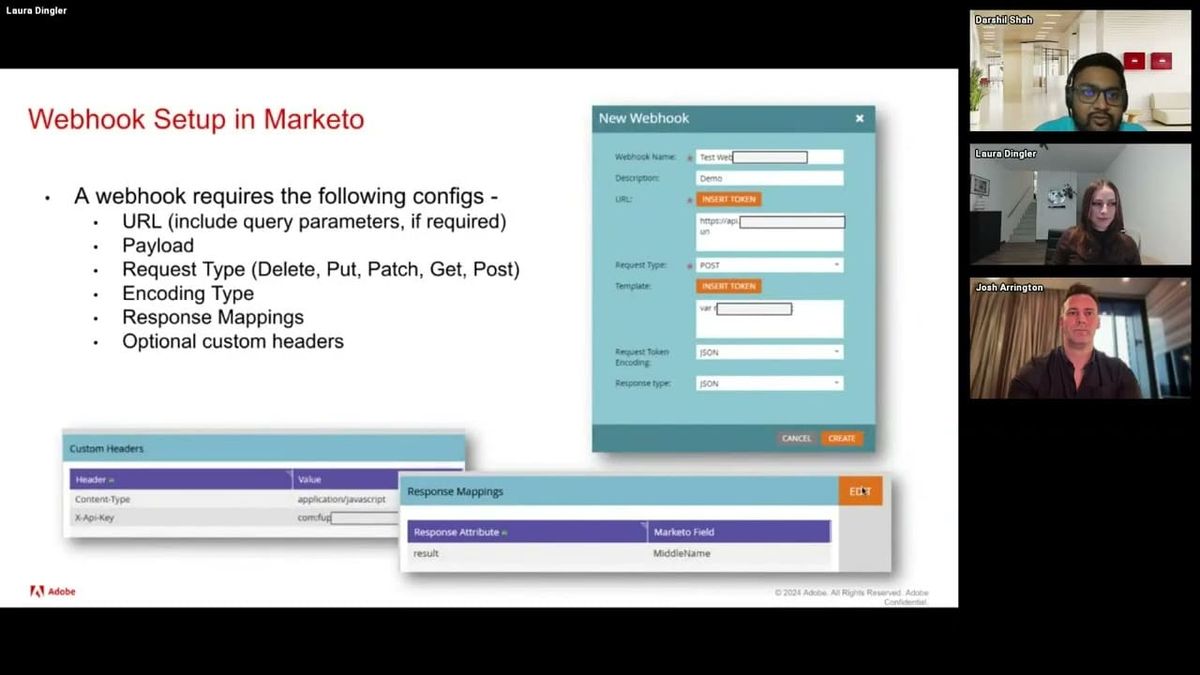
The 'Webhook is Called' trigger — combined with Response and Error Type constraints — lets you build retry logic and error recovery entirely within Marketo smart campaigns. For predictable errors (service timeouts, known failure states), you can trigger a retry flow automatically. For unexpected errors, alert notifications fire to you or your developer with error details attached. Any lead that hits an error gets added to a static list for activity log investigation, keeping your error triage organized without external tooling.
The session also clarified the hard limits that make this error handling necessary: webhooks process one record at a time, so 100,000 calls at 50ms each takes roughly 1.5 hours to complete. The 30-second timeout means Marketo logs a timeout error and moves on — but a timeout doesn't confirm the call failed, it just means Marketo stopped waiting. Webhook flow steps are also trigger-campaign-only; nesting via 'Campaign is Requested' to run them in batch is technically possible but explicitly flagged as not recommended.
The distinction between Response (the payload returned) and Error Type (the HTTP status reason phrase) as separate constraints gives you granular branching — you can route different error conditions to different recovery paths rather than treating all failures identically.
"A timeout error doesn't mean that the SMS wasn't sent. It just means that Marketo doesn't know what happened. It ran out of time."
Self-service flow steps process 10,000 records in 10 batches — webhooks send them all at once and time out
The architectural difference between webhooks and self-service flow steps isn't cosmetic. Webhooks fire all records simultaneously and require your backend to respond within 30 seconds — for a 10,000-lead flow, every single request hits your endpoint at once. Flow steps send in batches of 1,000 with a callback URL, so your backend processes 10 sequential batches on its own timeline with no timeout ceiling. The distinction matters most in two scenarios: high-volume sends (like an SMS blast to thousands of gym members) and multi-step flows that depend on a response before continuing.
The gym SMS scenario surfaces a specific failure mode practitioners often miss: running a webhook in a batch campaign looks like it succeeds in the UI but logs 'failed — cannot call webhooks in batches' in the activity log. The workaround of nesting trigger campaigns gets around the batch restriction but still exposes you to the 30-second timeout at volume, and worse, a timeout error doesn't confirm failure — Marketo simply doesn't know what happened.
Flow steps also add purposefully structured UI — labeled fields, icons, and fields tailored to the specific action — versus webhooks' single-field interface of just 'which webhook to call.' The underlying capability difference (batch processing, async execution, custom fields, per-flowstep activity logging) makes flow steps a structural upgrade rather than just a UX improvement.
"If you try to run them in batch, they will look like it worked fine, but if you look in the activity log, you'll see this — failed, cannot call webhooks in batches."
Flow step async execution, per-step activity triggers, and dynamic dropdowns — three capabilities webhooks can't replicate
Three flow step capabilities with no webhook equivalent: first, async execution that holds the flow until a response returns — critical for any flow that fetches data (e.g., a member's gym activity summary) and then uses it in the next step (e.g., populating an email token). With a webhook in step one, Marketo immediately executes step two before the response arrives, producing blank tokens or requiring manual wait-step workarounds. Flow steps gate progression automatically.
Second, each self-service flow step generates its own unique activity type with storable attributes — data that doesn't have to live on the lead record. In the gym scenario, a 'member activity updated' activity stores visit count as a constraint, enabling a smart campaign filter that branches: members with more than one visit get the monthly recap email; members with zero visits get a motivational re-engagement message. This branching is impossible with webhooks, which have no dedicated activity type.
Third, dynamic dropdowns pull their option lists from your backend system and refresh automatically every 24 hours by default, with manual refresh available in Admin. In a large gym network where locations open and close regularly, this means the location picklist in your flow step always reflects current active locations — no manual list maintenance required. Webhooks have no equivalent field type.
"Unlike webhooks, flowsteps come with their own unique activities. For each self-service flowstep you have, it has its own activities and own filters where we can store information about the action — even if it's not stored on the lead record itself."
Three build paths for self-service flow steps: Workato packaged, N8N with downloadable template, or custom code on Adobe IO
Building a self-service flow step requires an endpoint layer that handles Marketo's callback pattern — not every integration platform supports the specific multi-endpoint structure required. Workato is the only pre-packaged solution currently available with a purpose-built flow step component. N8N works well and is a viable option for teams without enterprise iPaaS budgets; a pre-built N8N workflow template was shared (with QR code and download link in the session) that handles the full callback structure. For teams with developer resources, custom code deployable to Adobe IO, Azure, or AWS is also viable — Adobe's GitHub has an example. The underlying structure, regardless of platform, is described as 'a fancy wrapper on top of a webhook.'
Installation is handled through Admin > Service Providers, where you add a URL pointing to your deployed service. Field mapping — what goes out of Marketo and what comes back — is configured via dropdown UI rather than dot notation, making it significantly less error-prone than webhook response mapping. An API key secures the flow step so it can't be called without authorization.
Use cases explicitly called out where flow steps outperform webhooks: AI model integrations (prompt/response cycles frequently exceed 30 seconds at batch scale), lead enrichment, bulk deduplication (flagged as Marketo's longest-running API process), custom object create/update/delete (no native flow action exists), CRM integrations with non-Salesforce/Dynamics systems or non-standard objects, and internal messaging to Slack or Teams with approval workflow interactivity.
"It's just a kind of fancy wrapper on top of a webhook in the end. I think this template could be very helpful and even if you're a developer, it's kind of great to be able to see it visualized — how the data flows and all the endpoints there."
Also mentioned in this video
- Webhooks fundamentals in Marketo, covering configuration location in Admin,… (6:01)
- Sending and receiving data via webhooks, including query parameters, payload… (10:20)
- Daril covers webhook authentication types from weakest to strongest (13:40)
- Key self-service flow step use cases including custom object management,… (35:26)
Summarised from Adobe Marketo Engage User Groups · 52:58. All credit belongs to the original creators. Streamed.News summarises publicly available video content.