Original source: Adobe Marketo Engage User Groups
This article is an editorial summary and interpretation of that content. The ideas belong to the original authors; the selection and writing are by Marketo Ops Radar.
This video from Adobe Marketo Engage User Groups covered a lot of ground. 2 segments stood out as worth your time. Everything below links directly to the timestamp in the original video.
If you've ever untangled a Marketo instance where contacts somehow ended up in three nurtures simultaneously, this architecture is worth studying. The centralized control program pattern solves a structural problem that smart list hygiene alone can't reliably prevent.
A Centralized Control Program Architecture That Eliminates Multi-Nurture Overlap in Marketo
A practitioner detailed a structural approach to managing Marketo nurture programs through a single default program acting as a centralized control layer. The architecture relies on three custom string fields — one tracking which nurture a person is currently assigned to, one tracking their nurture status, and one functioning as an append-style log of historical nurture membership. Rather than embedding enrollment logic in each individual engagement program, all assignment decisions flow through a single smart campaign using ordered choice steps, ensuring a person can only land in one nurture at a time regardless of how many eligibility criteria they satisfy.
The choice-step ordering is doing meaningful work here: because Marketo exits a person from the flow once the first matching choice is satisfied, priority conflicts are resolved by sequence rather than requiring mutually exclusive smart list logic. This significantly reduces the maintenance burden when adding or retiring nurture programs, since changes are made in one place rather than propagated across multiple engagement programs. The engagement programs themselves retain responsibility for stream routing but delegate enrollment entirely to the control program.
Exhaustion handling is equally deliberate. A secondary campaign listens for a status change to 'exhausted' and re-triggers the same assignment campaign, meaning the system self-routes people to the next appropriate nurture without additional intervention. Status options are kept minimal — normal, paused, do not nurture — which keeps the operational logic clean and extensible. The nurture log field uses an append pattern, preserving a full history of which programs a person has moved through over time, which addresses a common visibility gap in multi-program nurture setups.
"There is only one campaign that is assigning people to however many nurturers that you have."
Measuring Nurture Impact Without Waiting for Perfect Data
A presenter laid out a practical framework for proving nurture value across B2B and B2C contexts, organized around top-of-funnel and bottom-of-funnel outcomes rather than vanity engagement metrics. For B2C, control group measurement was presented as the most defensible approach — with the clarification that the holdout group does not need to be 50% of the audience; as little as 5–15% can establish statistical significance at sufficient volume. For B2B, where withholding nurture from a meaningful portion of the audience is often not practical, year-over-year or quarter-over-quarter benchmarking was offered as a workable alternative.
On the bottom-of-funnel side, the discussion focused on pipeline influence reporting — specifically the proportion of open opportunities that had prior nurture touchpoints — as well as ACV and AOV comparisons between nurtured and non-nurtured customers. Salesforce campaign influence was identified as the connective tissue that makes this analysis possible. Brand awareness metrics, while harder to quantify, were framed as legitimate measurement targets via organic search signals, brand mention monitoring, and content engagement downstream of nurture sends.
The broader point was directed at practitioners who stall on building nurtures because they lack a reporting framework: incomplete measurement is not a reason to delay execution. Reporting infrastructure can be developed iteratively as volume accumulates and stakeholders begin asking specific questions.
"A nurture can only work if it actually runs. Build it, and if you don't have reporting already, you can build it as you go."
Also mentioned in this video
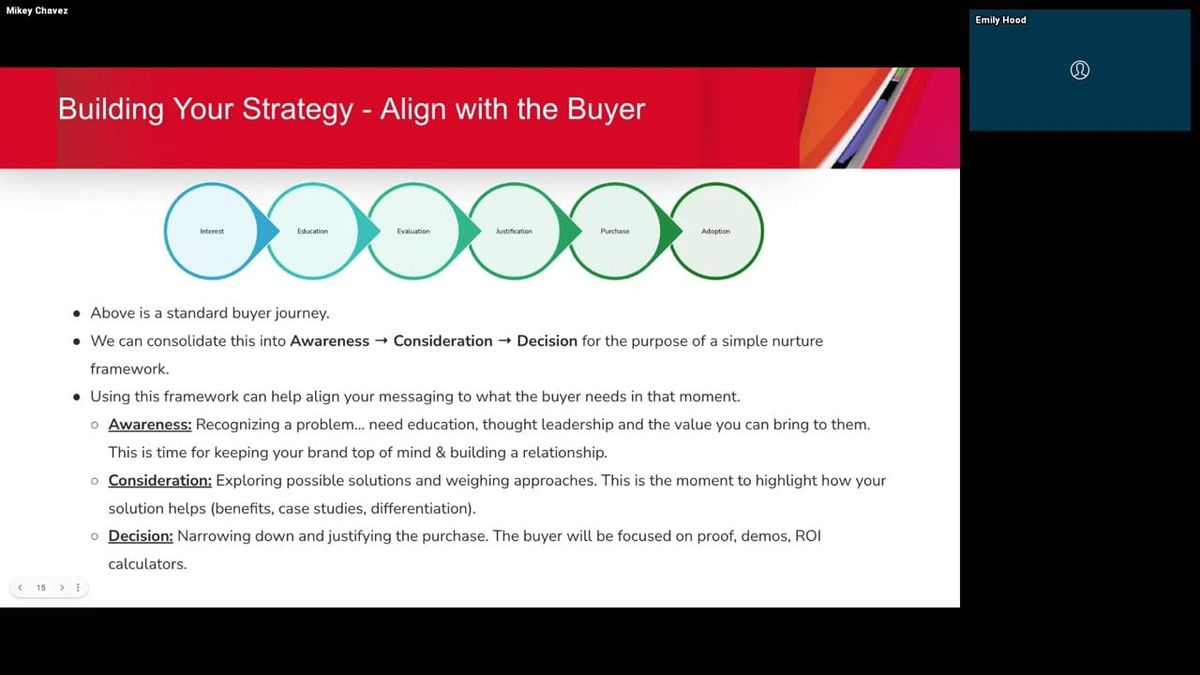
- A buyer journey framework (awareness, consideration, decision) as the strategic… (8:23)
- Emily covers the importance of personalization and dynamic content within… (27:36)
Summarised from Adobe Marketo Engage User Groups · 37:00. All credit belongs to the original creators. Streamed.News summarises publicly available video content.