Original source: Adobe Marketo Engage User Groups
This article is an editorial summary and interpretation of that content. The ideas belong to the original authors; the selection and writing are by Marketo Ops Radar.
This video from Adobe Marketo Engage User Groups covered a lot of ground. 4 segments stood out as worth your time. Everything below links directly to the timestamp in the original video.
If your Adobe Identity Management migration is on the horizon, this firsthand account maps the failure modes that weren't in the documentation. The issues are largely resolved — but knowing what to verify before you cut over is still operationally valuable.
Adobe Identity Migration War Stories: What Early Adopters Encountered and What's Since Been Fixed
A practitioner who migrated early to Adobe Identity Management shared a candid post-mortem covering a range of issues that emerged immediately after cutover. The most disruptive was a severe performance regression — load times of 30 to 33 seconds per page navigation that persisted for roughly three months before resolving. Bookmark and URL breakage at migration time was also flagged, though subsequent process changes by Adobe appear to have addressed this for later migrations.
Beyond performance, the practitioner highlighted structural friction introduced by the Adobe Admin Console itself. Organizations running multiple Adobe products hosted in different regions found themselves managing separate, non-unified admin consoles — a complexity that required Adobe's direct involvement to even assess resolution options. User provisioning introduced a quieter but operationally significant problem: adding users through the Admin Console syncs them to Marketo with only a default marketing role assigned, requiring a manual follow-up step inside Marketo to apply correct role configurations. A related bug — where only API users were visible in Marketo and human users could not be assigned roles at all — was also reported, though since resolved.
The overall arc of the account is cautiously optimistic: most documented issues have been addressed, and the Admin Console offers genuine consolidation value for organizations running a broader Adobe stack. But the session surfaced a clear pattern — early migration cohorts absorbed undocumented edge cases so later ones wouldn't have to. Teams preparing to migrate should verify current status of each issue type with Adobe support and build in buffer time for role remediation workflows.
"We had Marketo load times of 30, 33 seconds — every time you would load Marketo and go to a different entity or refresh your screen it would take 33 seconds before it loaded, and that's not a way to work with Marketo."
▶ Watch this segment — 1:08:15
From Six-Month Campaigns to One Month: How a Multi-Division Global Team Restructured Content Operations
One marketing operations team managing four structurally distinct business divisions across 60-plus countries documented a phased approach to deploying an AI-assisted content platform at scale. Rather than treating the organization as a single entity, the team configured separate instances per division — each with its own content rules, user settings, tagging taxonomy, and workflows — reflecting the reality that what looks like one company functions operationally as four. This architectural decision, though more complex upfront, prevented the usability failures that a one-size-fits-all deployment would have created for local marketers.
The rollout strategy centered on engagement tiering: countries were ranked by the likelihood of active participation and feedback quality, then sequenced across four tiers from highest to lowest engagement. The POC phase used this structure to generate meaningful translation quality data — building hundreds of emails across more than 20 countries and languages — before committing to full deployment. Critically, the POC surfaced sufficient interest across all divisions, including one that had not participated in the pilot, validating the approach before the development and implementation phases began.
The before-and-after process comparison for one representative division illustrated the structural change clearly: a six-month campaign production cycle anchored by agency dependencies, human translation handoffs, and sequential review gates compressed to a one-to-three month cycle with AI handling content generation and translation, and automated Marketo import replacing manual implementation. Agency relationships were eliminated entirely. The team framed the current state as an early activation phase, with expectations that briefing and local review timelines will continue to compress.
"Before we had six months time to market — now we are hoping to gain one to two months. We are in some divisions down to one month."
Governance Layers, Persona Parameters, and HTML-Safe Translation: Inside an AI Content Platform's Operational Architecture
A live demo session revealed the operational mechanics behind an AI-assisted email content platform integrated with Marketo, surfacing several non-obvious design decisions relevant to practitioners evaluating similar tooling. The governance model operates at three levels — global rules covering tone of voice and writing constraints, market-level rules handling localization-specific terminology and translation conventions, and task-level prompt templates controlling how specific content generation requests are executed. This layered structure means that AI outputs are shaped by compounding rule sets rather than a single system prompt, allowing global brand standards and local market requirements to coexist without manual reconciliation at the content level.
Persona-based personalization is implemented as structured parameter sets — goals, motivations, fears, and value propositions — that the AI uses as context when generating or rewriting content for specific audience segments. The demo showed simultaneous generation of persona-specific variants across multiple audience types within a single project, with the system applying its understanding of each persona's priorities to headline, body, and CTA copy independently. Practitioners can interrogate the AI's reasoning for any given personalization decision, enabling a review process that is auditable rather than opaque.
On the Marketo integration side, the platform supports two export modes: static emails into specific program folders, or a single dynamic email with segmentation logic into a global or regional folder. Translation preserves HTML formatting rather than regenerating markup, which avoids the common failure mode of AI-generated translations that break template structure. Local market review is handled through a project-sharing model where regional users interact with content in their own language and can make edits or flag approvals directly within the platform before export.
"All of the global rules and local rules are put into effect to guardrail the output quality so that it matches the brand voice and the way to translate."
POC Metrics That Justified Full Deployment: Translation Review Times and Production Cycle Reductions
The POC phase for this multi-division global deployment was designed specifically to answer the translation quality question: could AI-generated translations meet local market standards without significantly increasing review burden on regional marketing staff? The data collected showed that 91% of AI translations were proofread and finalized in under 10 minutes, with 98% completed within 15 minutes. For a team operating across 20-plus languages with limited local marketing headcount in many markets, this metric directly addressed the feasibility concern that had most risk attached to it.
Early production results following full implementation reinforced the POC findings at the process level. External agency spend was eliminated entirely for one division. Content creation time — from campaign brief to final content ready for use — dropped from two months to approximately 30 minutes. Time-to-market for one division moved from six months to one month, with the expectation that remaining divisions would converge on a similar cycle. These are self-reported early results from an activation phase, and the team acknowledged that some of these gains are still stabilizing across all four divisions.
The pattern worth noting for other practitioners is the deliberate sequencing: POC metrics were used to validate a specific, high-risk assumption (translation quality) before committing to full rollout investment. The production metrics that followed are compelling, but they are the downstream outcome of a structured validation process rather than a speculative projection made at the outset.
"91% of the test results were being finalized and proofread in less than 10 minutes — and that was a huge win, helping us see the possibilities and the success in it."
Also mentioned in this video
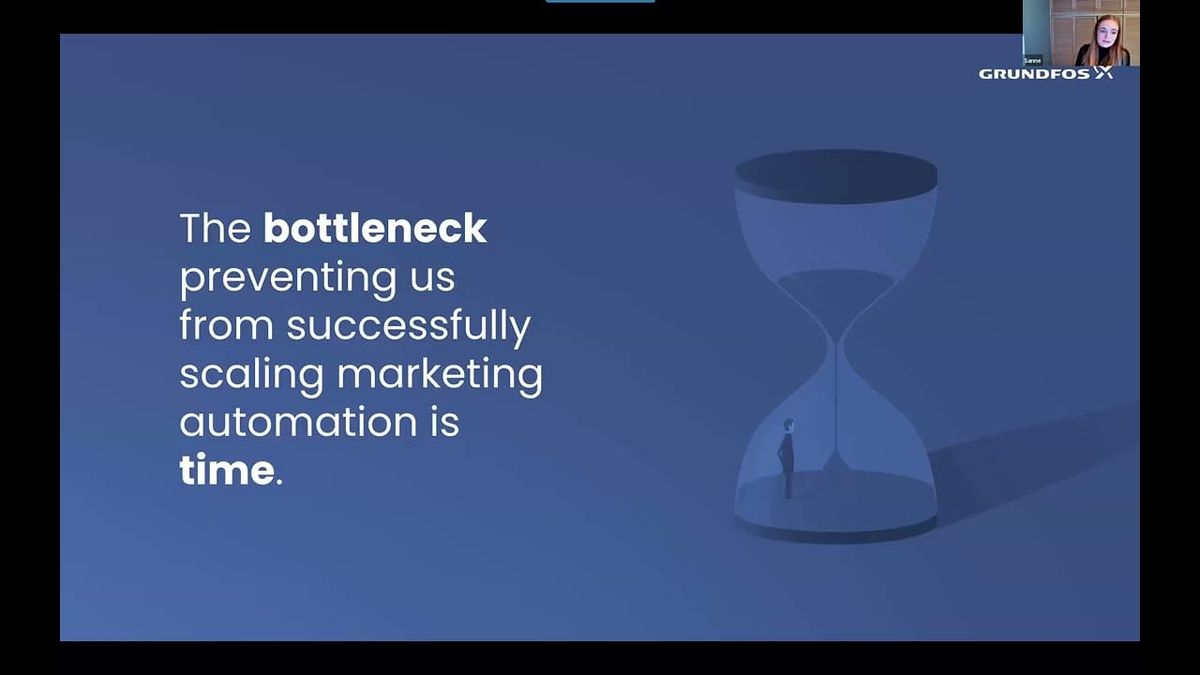
- Grundfos's core marketing automation challenges, including slow content… (10:08)
- Magnetti's platform vision and solution, explaining how it uses AI to enable… (12:32)
- Q&A session covering legal and compliance considerations for AI adoption, how… (50:44)
- An overview of the Adobe Identity Management migration for Marketo users,… (59:22)
Summarised from Adobe Marketo Engage User Groups · 1:13:51. All credit belongs to the original creators. Streamed.News summarises publicly available video content.