🌐 Also available in: 🇩🇪 Deutsch
Original source: Adobe Marketo Engage User Groups
This article is an editorial summary and interpretation of that content. The ideas belong to the original authors; the selection and writing are by Marketo Ops Radar.
This video from Adobe Marketo Engage User Groups covered a lot of ground. Marketo Ops Radar selected 6 key moments and summarises them here. Everything below links directly to the timestamp in the original video.
Your team might be using AI for copy and ideas, but this discussion shows how advanced teams are pushing the boundaries. They are treating AI as an autonomous operations partner rather than just an assistant.
Practitioners Push for Autonomous AI to Act, Not Just Analyze
Practitioners at AI-heavy organizations are already using external AI for complex tasks like manipulating email code, building reports, and automating repeatable jobs. They are moving past simple content generation to build custom skills that handle operational tasks outside of their marketing automation platform, pulling data out, transforming it with AI, and plugging it back in.
This signals a growing frustration with platforms that lack direct AI connectivity, pushing for a future where AI doesn't just provide insights but autonomously acts on them. The demand is for AI to monitor operations, identify issues like sync failures, and fix them within defined guardrails.
"I think that's where we're going is not just have the data, not just interpret the data, but act upon the things within a confined, you know, area."
▶ Watch this segment — 1:33:23
Practitioners Want AI for High-Volume, Repetitive Tasks, Not Just QA
A discussion highlighted a significant need for AI to handle high-volume, repetitive, and definitive operational tasks, especially in smaller teams. Use cases like bulk-updating a picklist value across hundreds of forms or editing flow steps across multiple campaigns are seen as low-hanging fruit where AI can provide immediate value beyond simple QA.
This moves the conversation from AI as a safety net to AI as a core productivity engine. The future vision involves AI generating entire campaign structures from scratch, based on a set of defined organizational preferences and context.
"This is perfect for AI because it is repeatable and definitive."
Automate Program QA by Validating Against Predefined Business Rules
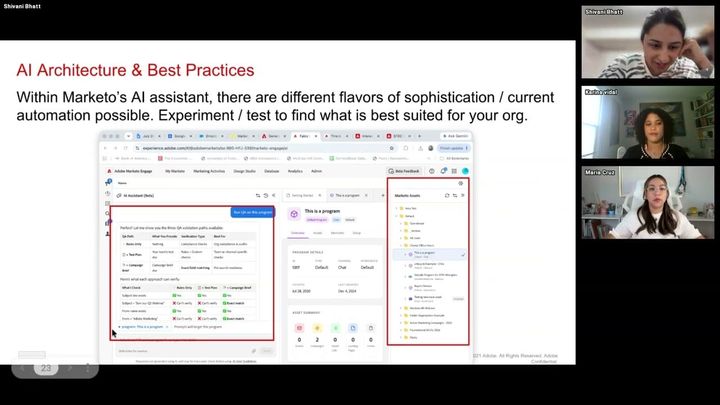
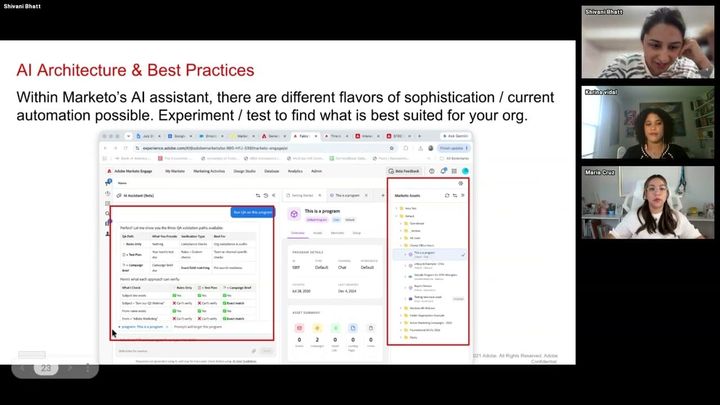
A presenter demonstrated a feature designed to automate the manual QA process for marketing programs. The tool validates a program against a set of predefined organizational rules, a CSV checklist, or a campaign brief, streamlining compliance with internal standards. It generates a clear report detailing successes and failures for the practitioner to review and act upon.
This represents a practical step toward reducing the manual overhead of governance. The future potential is for AI to not only identify these issues but also to perform automated corrections based on the defined rules.
"It's a very manually intensive process to go through every program to check that all of those rules are being complied with. And so the idea here is that we're trying to make this more automated."
Enable Self-Service for Non-Technical Teams, But Ensure Data Write-Back is a Prerequisite
Practitioners identified a strong use case for simplified campaign-building tools: enabling non-technical teams like HR or partner teams to create their own communications independently. This approach allows MOPs to maintain governance and brand standards while offloading low-value requests that don't require full marketing operations involvement.
However, a critical caveat was raised. Any such system is considered unviable without robust, bidirectional data write-back to the core marketing automation platform and CRM for attribution and integration with standard reporting.
"Without the data writing back to Marketo, I don't want to run our marketing campaigns through that because that'll just break the whole attribution model."
▶ Watch this segment — 1:19:26
Use an AI Assistant to Automate Data Cleaning During List Imports
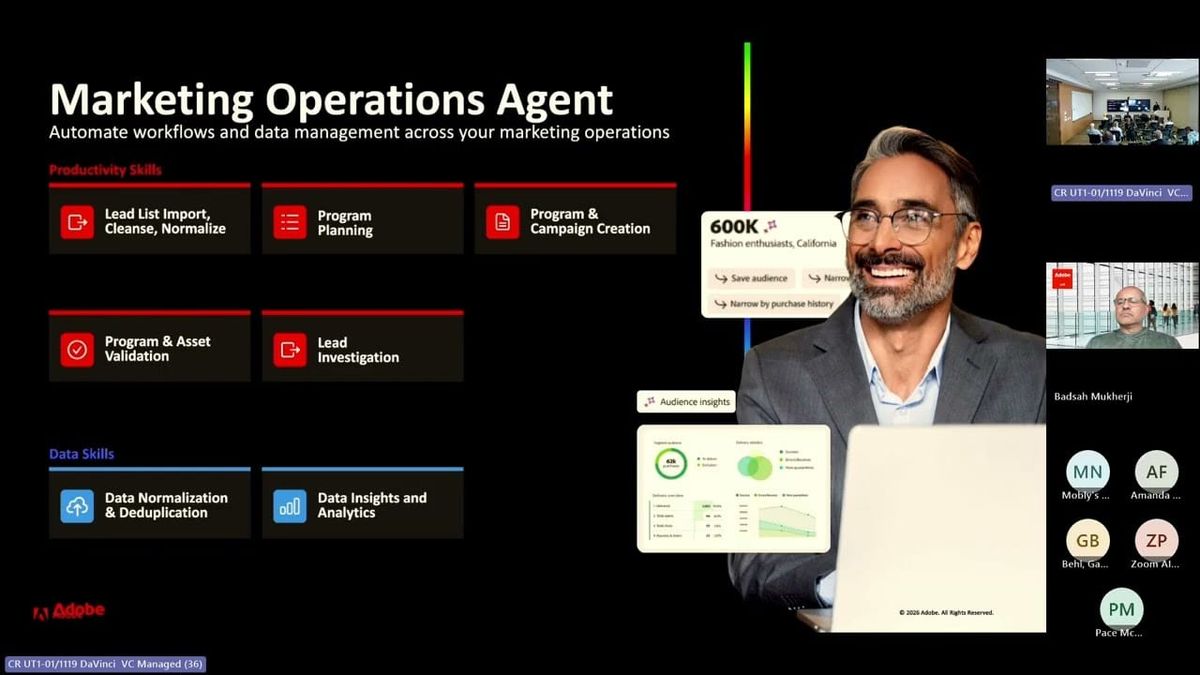
A demonstration showed how an AI assistant can streamline the process of importing and cleaning a lead list. The tool automates common data quality tasks like deduplication, normalizing country and state codes, trimming whitespace, and standardizing field values like name casing before the data enters the main database.
This approach shifts data cleansing from a series of manual, post-import smart campaigns to an automated, in-memory process. It improves data hygiene from the point of entry rather than requiring reactive cleanup later.
"Before that list of leads hits my database, while it's in memory, I want to clean up the data like normalize certain field values, maybe trim whitespace."
Distinguish Between Webhooks and Self-Service Flow Steps for Synchronous Processing
A practitioner asked about calling external AI agents to perform actions like updating Salesforce data. It was confirmed this is achievable today using standard webhooks, which trigger an external process asynchronously, meaning the smart campaign flow continues immediately without waiting for a result.
For use cases requiring the workflow to wait for a response before proceeding—such as data transformation or enrichment—a practitioner should instead explore self-service flow steps. This mechanism is designed for synchronous processing, preventing race conditions where decisions are made on incomplete data.
"I would rather it wait to complete, especially with data transformation is like clean up the data and then make a decision on the data."
Also mentioned in this video
- The 'Marketo AI' tile, which leads to an AI-first conversational experience… (10:10)
- As a good enhancement idea, confirming it's not currently supported but can be… (18:09)
- Callable agents, explaining how users can preconfigure agentic skills to be… (25:02)
- An audience member inquires if the Marketo Customer Engagement Platform (MCP)… (31:05)
- Audience members discuss the utility of the program QA feature, asking if… (41:21)
- Project Halo as an experiment to simplify campaign building for any marketer… (1:07:12)
- Audience members ask about Project Halo's role-based permissions, its current… (1:15:35)
Summarised from Adobe Marketo Engage User Groups · 1:44:42. All credit belongs to the original creators. Marketo Ops Radar summarises publicly available video content.