
North America Virtual Marketo User Group: Adobe SUMMIT 2025 recap — Key Takeaways
If your instance carries years of technical debt, the Salesforce sync rebuild and token improvements may matter more to your day-to-day than any AI demo. Here is why practitioners are treating infrastructure updates as the real signal from this year's roadmap.

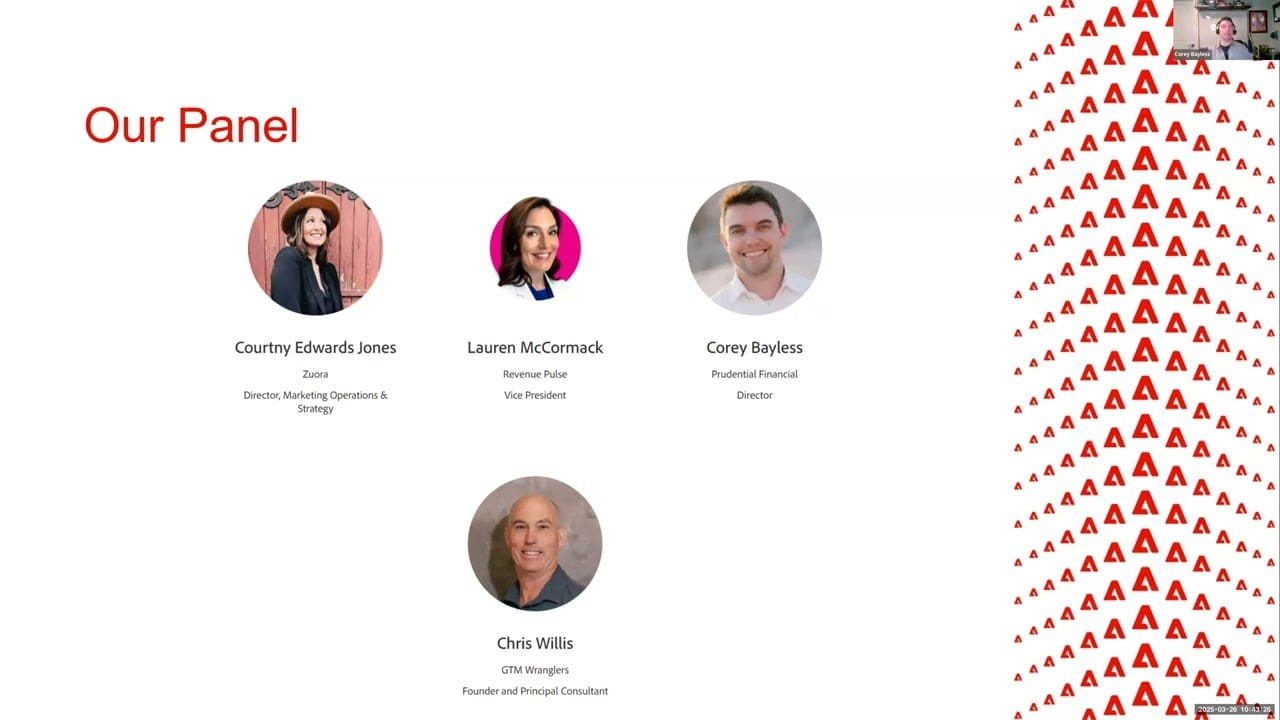
Adobe Marketo Engage User Groups | 20250331 | 52:02
This session from Adobe Marketo Engage User Groups covered a lot of ground. 3 segments stood out as worth your time. Everything below links directly to the timestamp in the original video.
Salesforce Sync Rebuild and Global Tokens: Why Infrastructure Wins Matter as Much as AI Demos
Topic: new-features | Speakers: Chris Willis, Lauren McCormack, Courtny Edwards-Jones, Corey Bayless
While AI features dominated Summit headlines, a recurring pattern among experienced practitioners was equal or greater enthusiasm for foundational infrastructure improvements — particularly a ground-up rebuild of the Salesforce CRM sync with improved error visibility and more granular sync reporting. For teams carrying significant technical debt or managing complex multi-workspace instances, this type of improvement compounds in value over time in ways that flashier capabilities do not.
Global tokens and trigger tokens also drew attention as underappreciated operational gains. A practitioner noted that for teams running large or fragmented instances — multiple workspaces, inherited configurations, legacy logic — token improvements that seem minor in isolation can unlock meaningful workflow efficiencies at scale. The framing was explicit: small operational gains in high-volume, high-complexity environments translate into large structural improvements.
The agentic AI demonstration also landed as a genuine inflection point: a full five-email nurture stream, complete with creative assets and a landing page, generated in under 30 seconds from a prompt. The honest framing from practitioners was that this represented weeks of cross-functional coordination compressed into seconds — with the caveat that realizing this efficiency in production still requires governance, training, and institutional knowledge to validate outputs.
Key takeaways:
- Infrastructure improvements like CRM sync rebuilds and enhanced error visibility deliver disproportionate value in instances with technical debt or complex multi-workspace configurations.
- Global and trigger token improvements are high-leverage for teams managing scale — small token changes propagate across many programs and workflows simultaneously.
- Agentic AI can now generate full nurture journeys with assets in seconds, but the practitioner value depends on having the expertise to govern, validate, and deploy those outputs responsibly.
- Evaluating new features through the lens of your specific instance complexity — not just general capability — is the more useful frame for prioritization.
- The most durable Summit takeaways for ops-heavy practitioners often come from platform stability and configurability improvements, not only headline AI features.
Why this matters: If your instance carries years of technical debt, the Salesforce sync rebuild and token improvements may matter more to your day-to-day than any AI demo. Here is why practitioners are treating infrastructure updates as the real signal from this year's roadmap.
🎬 Watch this segment: 20:00
Snowflake-Backed BI Analytics and a New Journey Builder UI Signal a Competitive Repositioning for Marketo
Topic: new-features | Speakers: Corey Bayless, Chris Willis
Two product directions stood out among experienced practitioners reviewing Summit announcements: a new advanced BI analytics capability backed by Snowflake, positioned as a meaningful replacement for Revenue Cycle Explorer, and a redesigned person journey builder UI. Both were discussed not just as feature additions but as competitive repositioning — addressing longstanding capability gaps that practitioners had quietly tolerated while defending the platform.
The BI analytics tooling resonated most with lifecycle-focused practitioners who have relied on RCE for foundational reporting despite years of minimal investment in that layer. The Snowflake backing was called out specifically for speed and presentation-readiness — qualities RCE has lacked. The journey builder, meanwhile, was framed as closing a UX gap that competitors have exploited in vendor evaluations, particularly in organizations running simpler nurture needs where visual journey interfaces have been a differentiator for other platforms.
A third capability — an image-to-HTML AI editor that can interpret hand-drawn sketches and convert them to usable email templates — was highlighted as both practically useful (eliminating the long-standing friction of leaving the email editor to upload images) and symbolically significant as an indicator of where the product is heading. Practitioners noted that early-stage AI tooling in the platform should be evaluated for trajectory, not just current capability.
Key takeaways:
- The Snowflake-backed BI analytics tool is the most significant upgrade to Marketo's reporting layer in years — practitioners with lifecycle reporting needs should evaluate it as a direct replacement for RCE.
- The new person journey builder UI addresses a genuine competitive gap, particularly relevant when defending Marketo against platforms that lead with visual simplicity.
- Inline image upload in the email editor is a small but meaningful friction reduction that compounds across high-volume campaign teams.
- AI-assisted email template generation from visual sketches is early-stage but worth tracking as a signal of the product direction.
- Platform flexibility and API remappability remain underappreciated Marketo strengths — worth reinforcing internally when platform comparisons arise.
Why this matters: If you have been defending Marketo in vendor reviews or struggling to extract lifecycle reporting from RCE, two Summit announcements directly address both pain points. Here is what practitioners found most strategically significant.
🎬 Watch this segment: 16:20
AJO B2B Orchestration and Interactive Webinar Enhancements: The Summit Sessions Worth Revisiting
Topic: use-case | Speaker: Corey Bayless
Among sessions flagged as high-value by practitioners, two areas stood out: the Adobe Journey Optimizer B2B and Marketo cross-platform orchestration demos, and updates to interactive webinar capabilities. The AJO B2B discussion centered on buying group orchestration — specifically, the ability for AI to aggregate multi-stakeholder engagement signals across many touchpoints and surface the most engaged buyer within a group, reducing the manual analysis that currently bottlenecks account-based motions. The agentic AI layer demonstrated the ability to auto-generate complete journey maps, campaign assets, and landing pages from a prompt, with practitioners estimating this compressed multiple weeks of cross-team coordination into under a minute.
The interactive webinar updates were flagged as an immediately actionable and underutilized capability: up to 12 included sessions, up to 500 attendees, at no additional cost, with generative AI enhancements available for on-demand versions. Practitioners noted this represents meaningful value that many mid-market teams have not yet incorporated into their program mix. The honest counterpoint raised was that some hands-on lab sessions were less successful due to technical issues, which was offered as a candid signal about what to weight when evaluating session formats versus live demos.
The roadmap sessions were described as the highest-value investment for longtime practitioners — particularly those approaching Summit with skepticism about pace of delivery. The framing was that seeing a year defined by product enhancements rather than announcements alone shifted the posture of experienced users toward cautious optimism.
Key takeaways:
- Interactive webinar sessions (up to 12 included, up to 500 attendees, no added cost) remain underutilized by many teams — the GenAI on-demand enhancement adds further reason to revisit this capability.
- AJO B2B's buying group orchestration, combined with AI engagement scoring across multiple stakeholders, represents a meaningful shift in how account-based programs can be structured and prioritized.
- Agentic AI journey generation — producing full campaign maps, assets, and landing pages from a prompt — is not yet in general availability but is worth tracking for its content supply chain implications.
- Roadmap sessions tend to deliver the highest signal-to-noise for experienced practitioners evaluating whether platform investment is accelerating.
- Lab and hands-on session quality can vary significantly; treating live product demos as the more reliable signal is a practical calibration.
Why this matters: If your team has not fully activated interactive webinar capabilities or explored how buying group AI signals could reshape your account-based motion, two Summit sessions make the case directly. Here is what practitioners found worth acting on now versus watching for later.
🎬 Watch this segment: 27:00
Content summarized from publicly available MUG recordings. Not affiliated with Adobe. Summaries reflect my interpretation — always validate before implementing in your environment.
This is a personal project by JP Garcia. I work at Kapturall but this publication is independent and not affiliated with or endorsed by my employer. All credit belongs to the original speakers and Adobe Marketo Engage User Groups. I curate and link back to source — I never re-upload or reproduce full sessions. Full disclaimer →