Original source: Adobe Marketo Engage User Groups
This article is an editorial summary and interpretation of that content. The ideas belong to the original authors; the selection and writing are by Marketo Ops Radar.
This video from Adobe Marketo Engage User Groups covered a lot of ground. 3 segments stood out as worth your time. Everything below links directly to the timestamp in the original video.
If your team is evaluating AJO B2B, the hardest question isn't technical — it's knowing which campaigns should stay in Marketo and which ones actually belong in the new tool. This session maps out that boundary with real implementation experience behind it.
How to Divide Responsibilities Between Marketo and AJO B2B Without Duplicating Effort
A recurring challenge when adopting AJO B2B alongside an established Marketo instance is knowing which tool should own which motion. One enterprise team described a clear division: Marketo remains the system of record for lead management, scoring, CRM integration, and evergreen nurture programs, while AJO B2B handles real-time, behavioral, and omni-channel orchestration — including anonymous journey support and point-in-time trigger events like form abandonment. The bidirectional sync between the two platforms means lead scores and statuses built in Marketo can directly personalize AJO B2B journeys, and real-time signals from AJO B2B can trigger Marketo nurture campaigns in return.
A shared asset library and unified analytics layer further reduce duplication, but the integration only delivers value if the operating model is defined before scale. One team noted that their pilot phase included use cases that were actually a poor fit for AJO B2B — time-based batch campaigns better suited to Marketo — and that sorting this out required deliberate trial and error. The lesson was that building governance documentation and an internal decision framework for 'which tool, when' needs to happen in parallel with technical implementation, not after.
The broader framing offered was that Marketo is fundamentally lead-centric, while AJO B2B is account- and buying-group-centric. Teams with active account-based marketing motions targeting enterprise or named accounts are the natural fit for AJO B2B expansion, whereas standard lead-based nurturing and sales alignment via CRM should remain anchored in Marketo. Journey governance — preventing conflicting or overlapping messages to the same contacts across both systems — was called out as a standing operational risk that needs explicit ownership.
"What quickly became clear in P0 is we definitely chose some use cases that aren't necessarily the best fit for AJO B2B. There was definitely some trial and error involved with more traditional time-based campaigns. Whereas ideally you want more the evergreen nurtures, those repeatable campaigns, or multi-channel experiences — those are better marketing use cases for AJO B2B compared to Marketo."
AJO B2B + Marketo Integration: Undocumented Gotchas, Implementation Timelines, and a Phased Buying Group Model
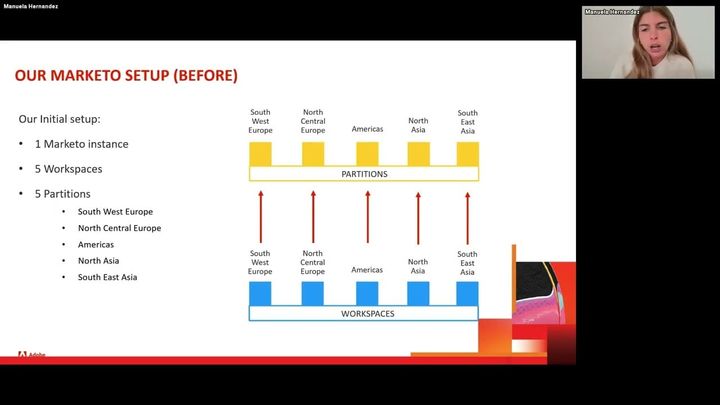
Several underdocumented technical issues emerged from one enterprise team's AJO B2B rollout that are worth flagging before any practitioner begins a similar implementation. First, AJO B2B can only sync with the default Marketo partition — a significant constraint for any instance using workspaces and partitions. Teams discovered this mid-rollout when leads failed to sync without any clear error, causing considerable troubleshooting time. Second, on initial connection, if engagement scoring has not been in use, AJO B2B triggers a backfill that converts all null engagement score values to zero across the entire database. For large instances, this mass update can create a substantial backlog in any downstream data warehouse receiving daily extracts — a consequence that was not anticipated and caused operational disruption. Third, the sync cadence between AJO B2B and the underlying CDP is slow enough (overnight or multi-hour windows) that testing journeys in a reasonable timeframe requires working directly with Adobe to force-trigger audience syncs — otherwise a single test cycle can take a full day.
On implementation timelines, the data foundation layer — standing up the real-time CDP with correct schemas, tested in dev and then production — took approximately seven to eight months for an enterprise-scale team. AJO B2B itself, once that foundation was in place, took one to two months to stand up, though that estimate was caveated by the need to accommodate an existing email prioritization and frequency-capping system. The total team involved spanned roughly five or six marketing stakeholders across channels plus a technical team of ten to twenty, reflecting the complexity of a large-scale deployment with custom integrations.
For teams earlier in their account-based marketing journey, a phased buying group maturity model was outlined: starting with persona-based content targeting (role types such as technical decision-maker or business decision-maker), progressing to rule-based buying groups tailored to specific solutions and ABM motions, and eventually evaluating whether a machine-learning model for automatic buying group identification is worth the investment. A final practical note: AJO B2B only accelerates execution speed if the marketing strategy side — journey design, content, ABM thinking — is already mature. Technical readiness without marketing strategy readiness will bottleneck the rollout regardless of platform capability.
"If you are using workspaces and partitions, you can only sync to one default partition from AJO B2B. When we initially launched we didn't know that and we were driving ourselves crazy trying to figure out why certain leads weren't syncing. Upon initial connection, if you are not using engagement score, there is an initial backfill where everyone in your instance — the engagement score has to be set to a number, it can't just be null. For us, we had to update several millions of records to just update to zero, and depending on how large your instance is, that could potentially cause a backlog if you're doing any sort of data extraction."
First-Wave AJO B2B Use Cases: What One Enterprise Team Prioritized for Initial Deployment
When an enterprise marketing operations team selected their foundational AJO B2B use cases, the choices reflected a deliberate mix of retention, acquisition, and adoption signals rather than simply replicating existing Marketo programs in a new tool. Use cases centered on behavioral triggers — form abandonment retargeting, credit balance threshold alerts — alongside account-level intent signal activation for enterprise segments using AI/ML-derived signals from both first-party and third-party data sources. Adoption-focused flows targeting existing customers and regional nurture programs rounded out the initial scope.
The through-line connecting these use cases was the shift from lead-level to account-level thinking. Intent signals aggregated at the account level were used to route contacts into relevant audience segments without waiting for batch sync cycles, enabling more timely engagement. The buying group construct was applied selectively — beginning with persona-based segmentation (decision-makers, technical buyers) as the most tractable starting point before more sophisticated account-level configurations.
For practitioners evaluating which use cases to prioritize first, this example suggests a useful heuristic: lead with use cases that are either behaviorally triggered or require real-time account-level data that Marketo cannot surface quickly enough on its own. Evergreen or time-based programs are better left in Marketo during initial rollout.
"We want to deliver the right message at the right time through the right channel — that's what marketing really is about if you want to break it down to one sentence."
Also mentioned in this video
- Adobe Journey Optimizer B2B Edition works, covering the buying group and… (9:36)
- AWS marketing's three strategic focus areas for leveraging AJO B2B through… (17:27)
- Of coordinated multi-channel journeys, cross-channel personalization using… (21:12)
Summarised from Adobe Marketo Engage User Groups · 54:59. All credit belongs to the original creators. Streamed.News summarises publicly available video content.