🌐 Also available in: 🇩🇪 Deutsch
Original source: Adobe Marketo Engage User Groups
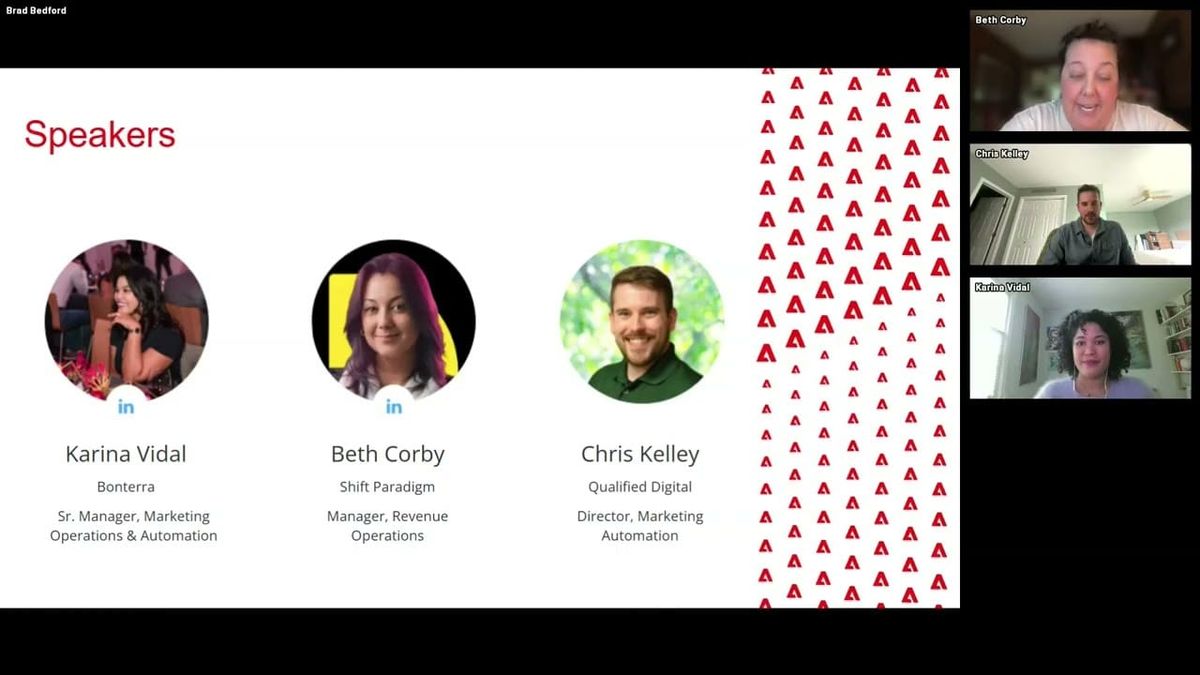
With: Karina Vidal · Beth Corby · Chris Kelley
This article is an editorial summary and interpretation of that content. The ideas belong to the original authors; the selection and writing are by Marketo Ops Radar.
This video from Adobe Marketo Engage User Groups covered a lot of ground. Marketo Ops Radar selected 6 key moments and summarises them here. Everything below links directly to the timestamp in the original video.
Before you dive into AI tools, is your instance built to support them? This checklist outlines the strategic and structural prerequisites for successful AI adoption.
A Practitioner's Checklist for AI Readiness in Marketo
A presenter shared a comprehensive checklist for preparing a Marketo instance for AI, framing it as a strategic tool implementation. This approach requires a defined AI strategy with clear business goals, established operational ownership, and explicit governance rules that dictate how AI agents can interact with the system and build campaigns.
The key implication is that technical readiness is insufficient without this organizational and strategic alignment. Foundational elements like consistent naming conventions, robust program templates, and a well-defined lifecycle are non-negotiable prerequisites for AI to function effectively and scalably within the platform.
"We want to make sure that you have rules in place for how AI is going to do building for you."
Build an Autonomous AI Infrastructure with Executable and Request Campaigns
A practitioner demonstrated how combining executable and request campaigns creates a robust framework for autonomous AI agents. In an example shared, an external AI agent analyzes inbox responses, categorizes the contact, and then triggers a request campaign in Marketo. This campaign, in turn, calls the appropriate executable campaign to process the record without direct human intervention.
This architectural pattern provides the necessary guardrails for AI, allowing it to operate within a predefined, scalable system. It effectively outsources decision-making and execution to the AI while maintaining operational control within Marketo's structured environment.
"The agent is the one doing its own reasoning, it's reviewing the inbox, it's categorizing them, and then it's calling upon Marketo to trigger the actions within the workflows."
Treat Naming Conventions as Machine-Readable Metadata for AI Agents
A key insight shared was that naming conventions are no longer just for human organization; they function as critical metadata for AI agents. By parsing consistent naming patterns, an AI can understand a campaign's type, function, and intended action, enabling it to make decisions and execute tasks autonomously. Recommendations included keeping names under 80 characters and using a single, consistent delimiter like an underscore.
Without this structured metadata, AI agents can become unreliable, requiring constant human-in-the-loop approval for every action. A disciplined approach to naming is therefore a direct prerequisite for achieving scalable, autonomous AI operations.
"With the naming convention, not only will it understand what type of campaign it is, it'll understand its function, it'll understand its action."
Use Executable and Request Campaigns for Scalable AI Orchestration
A practitioner framed executable and request campaigns as essential building blocks for AI-driven automation without accruing technical debt. Executable campaigns act as an orchestration layer, housing multi-step processes that can be called by other campaigns. In contrast, request campaigns serve as a decisioning layer, listening for triggers from other campaigns or AI agents to initiate specific workflows.
By centralizing common processes, like demo request routing, into a single executable campaign, teams create a consistent and scalable system. This allows AI agents to reliably leverage established logic instead of requiring the creation of redundant workflows for every new initiative.
"You can have a lot of processes within its flow step so that way it processes it before it moves on to the next flow step of the parent campaign that requested it."
Enable AI-Driven Content Creation with a Robust Token Strategy
A presenter explained how a well-structured token system is fundamental for AI-powered content automation. When an agent—via Marketo's platform or an external LLM—needs to clone a program and inject new copy, it relies on clearly named tokens to understand where to place specific content elements. This structure enables AI to generate, test, and QA copy autonomously.
This approach shifts the role of marketing operations from manual content updates to managing the templated systems that AI uses. It allows for a final human review before activation, blending automated efficiency with strategic oversight.
"If your tokens and your naming convention are very clear in what it is and what it does... then your AI can use that reasoning model to be able to decipher and leverage these tools."
A Glimpse into Marketo's Native AI for Program Creation and QA
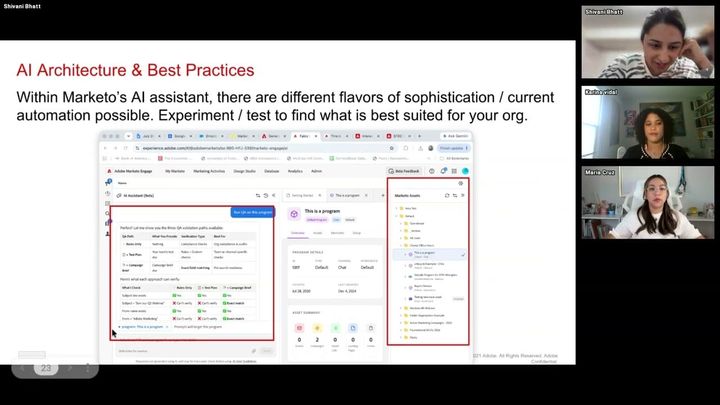
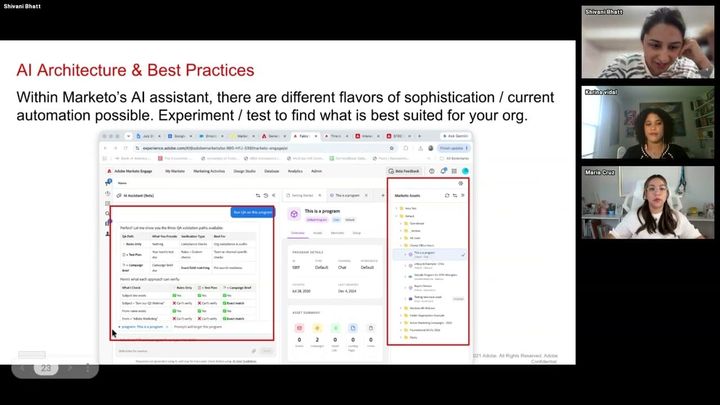
A practitioner shared a brief demonstration of Marketo Engage's new native AI capabilities. The workflow showcased a conversational interface where a user could prompt the AI to create a new program. The practitioner then uploaded a campaign brief, which the AI used to automatically populate an email's tokens with the relevant content from the document.
The demonstration concluded with an AI-powered QA check, where a prompt was used to audit the program and identify necessary fixes before launch. This highlights a shift towards using AI as an interactive assistant for building and validating campaigns.
"I ran a QA prompt where it essentially QA'd my program... and it showed me all the things that I needed to update in that program before I would send it."
Also mentioned in this video
- The session will cover various AI use cases in Marketo, focusing on how to set… (7:04)
- Marketo's evolution with AI, from relying on external integrations like… (7:36)
- Carina illustrates the expanded capabilities of Marketo with AI, moving beyond… (9:30)
- The exciting new ability to use AI directly within Marketo, mentioning beta… (11:30)
- Carina stresses the importance of signing the GenAI consent to fully leverage… (12:58)
- AI requires a strong foundation of consistent processes, clear naming… (14:01)
- AI does not automatically understand business context and requires a structured… (14:59)
- Naming conventions are becoming a foundational language for AI, allowing it to… (16:40)
- Carina reiterates the importance of managing AI like a team extension by… (21:28)
- The importance of a predictable and simple folder structure, typically aligning… (23:47)
- Critical governance areas for AI, including organizational standards, user… (25:56)
- A focus on executable and request campaigns as key components for setting up… (27:58)
- The concept of a Center of Excellence as a crucial framework for developing… (32:57)
- A Center of Excellence, with its standard program templates, creates reusable… (33:27)
- The expanded utility of tokens in the AI era, enabling autonomous and efficient… (35:13)
- Carina enumerates various types of Marketo tokens, specifically highlighting… (37:20)
- The importance of structured foundational elements like naming conventions,… (41:05)
- The importance of well-configured Marketo channels (tags) and their statuses,… (42:00)
- The critical role of a well-defined lead lifecycle in Marketo, enabling AI to… (43:24)
- Beth concludes that configured channels and life cycles provide AI with the… (44:23)
- The future of AI in Marketo, moving from traditional manual automation to an… (44:56)
- From Adobe Summit, including the Marketo AI conversational area for prompting… (46:35)
- Starting AI use cases with organizational problems to demonstrate ROI and… (48:54)
- Out-of-the-box AI capabilities in Marketo's email designer, allowing users to… (51:28)
- AI can be leveraged for decisioning and optimization by analyzing low… (52:32)
Summarised from Adobe Marketo Engage User Groups · 59:30. All credit belongs to the original creators. Marketo Ops Radar summarises publicly available video content.