Original source: Adobe Marketo Engage User Groups
This article is an editorial summary and interpretation of that content. The ideas belong to the original authors; the selection and writing are by Marketo Ops Radar.
This video from Adobe Marketo Engage User Groups covered a lot of ground. 4 segments stood out as worth your time. Everything below links directly to the timestamp in the original video.
If your sales team is still manually reading activity logs to prepare for MQL follow-up, this pattern offers a concrete architecture for automating that context-building step. The pitfalls covered here — activity age, noise filtering, token limits — are the exact details that determine whether the output is useful or just plausible-sounding noise.
Automating MQL Handoff Summaries: Using LLMs to Translate Activity Logs into Sales-Ready Context
A recurring challenge in MQL handoff is that sales receives raw activity logs with no narrative context — forcing reps to manually reconstruct intent before making first contact. A pattern presented in this session addresses this by building a service layer that extracts Marketo activity data via API (using bulk extract for larger volumes, standard REST for smaller ones), handles paging tokens, passes the filtered activity set to an LLM with a structured prompt, and writes the resulting summary back to Marketo as a readable field. The output is a constrained, approximately 100-word explanation of why the lead reached MQL status and what topics or products they showed intent for — delivered directly to the sales-facing record.
Several implementation pitfalls were discussed in detail. Pulling activity history beyond roughly six months tends to introduce noise and slow the workflow without meaningfully improving summary quality. Failing to filter out low-signal activities — such as basic email opens or system-generated events — before passing data to the LLM inflates token usage and degrades output relevance. Equally important is including high-signal metadata like form fill URLs, webpage visits, and asset links, which are precisely the contextual details that make LLM-generated summaries actionable rather than generic.
Token and output limits require deliberate management on both ends. Enforcing a strict word cap in the prompt prevents the LLM from generating verbose output that serves no practical purpose in a CRM field. On the activity input side, capping the number of activities passed per run prevents hitting LLM context window limits and keeps processing times predictable. A self-service flow step is recommended over a webhook for this pattern due to better field-passing flexibility and the absence of a hard timeout constraint.
"you wouldn't want to pull very old activity data so Uh again this is subject to how back you would want to go but we do not recommend you pull like really old activity data to analyze why this particular lead became MQL say based on a form field that they did like a year back."
Building a Custom AI Lead Scoring Model on Marketo: Architecture, Pitfalls, and the Cold-Start Problem
A detailed architecture for a custom AI-powered lead scoring model was presented, structured across three layers: a data layer (ensuring all relevant engagement events are tracked in Marketo and fields are accessible to the integration), an AI layer (a trained model deployed to a serverless cloud function), and the scoring program itself within Marketo (smart campaigns triggered by score thresholds). Training data requirements were emphasized — the model requires labeled historical records capturing both converted and non-converted leads, their firmographic attributes, and their engagement histories, all with normalized weightings across engagement types. The key differentiator from static scoring is continuous retraining on new conversion data, which prevents model drift as buyer behavior evolves.
Two significant failure modes were called out from practical experience. Overfitting occurs when too many input variables are used — a ceiling of roughly 20 features was recommended to keep the model generalizable to production data rather than optimized for training performance. The cold-start problem applies when building on a new or sparse instance: without sufficient historical conversion data, a purely AI-driven model cannot be reliably trained, and a hybrid approach — rule-based scoring until enough data accumulates, then transitioning to the full AI model — was recommended as the practical workaround.
From a Marketo integration standpoint, self-service flow steps were consistently recommended over webhooks for passing lead data to the scoring model and writing results back. The architecture also noted the importance of giving higher weight to high-intent signals (such as pricing page visits) relative to lower-signal events (such as email opens), and flagged model versioning and bias auditing as ongoing operational responsibilities rather than one-time setup tasks.
"a lot of time it happens that the model performs really well on the training data but it fails in production. Uh this could be issue wherein you are you know adding too many features."
A Step-by-Step Implementation Pattern for LLM-Driven Lead Qualification Inside Marketo
A concrete implementation roadmap for integrating LLM-based lead qualification into Marketo smart campaigns was presented, covering the full sequence from service setup through to feedback loop design. The pattern centers on passing ICP context — defined buyer personas including firmographic criteria, engagement signals, and revenue indicators — alongside individual lead data and engagement history to an LLM via a self-service flow step. The LLM returns a qualification score and next-step recommendation, which drives smart campaign routing: qualified leads are passed to sales, non-qualifying leads enter nurture. Critically, the pattern treats ICP definitions as living inputs that are refined over time as conversion data accumulates and buyer criteria evolve.
Prompt design was flagged as a common point of failure. Vague prompts without ICP context or buyer stage information produce unreliable scores. The recommended approach is to construct prompts that pass structured context — not just lead fields — so the LLM has the criteria it needs to make a consistent, explainable qualification decision. Error handling was also emphasized: implementations without explicit failure logging and retry logic (such as exponential backoff) become operationally fragile at scale. Data quality was highlighted as a prerequisite — the principle that degraded input data produces degraded LLM output applies directly here, and clean, standardized fields should be confirmed before enabling the integration.
Compliance was raised as a non-optional consideration. Passing lead data to external LLM APIs requires confirming that the organization's data processing agreements and applicable privacy regulations permit that data transfer. The session presented this not as a theoretical concern but as a concrete implementation gate that should be resolved before going to production.
"clean standardized lead fields is something that you would always always want to prioritize before you know implementing any of the AI use cases."
Self-Service Flow Steps vs. Webhooks: Why the Distinction Matters for AI Integration in Marketo
Self-service flow steps were framed in this session as the preferred integration pattern for connecting Marketo to external AI services — not just as a technical preference, but as a structural enabler for AI use cases that webhooks cannot reliably support. The core behavioral difference is how each approach handles volume: where a webhook makes one HTTP call per record, self-service flow steps use intelligent batching, automatically grouping records into jobs and reducing a thousand individual calls to a small number of batched requests. This has direct implications for rate limits, external API costs, and operational stability at scale.
Beyond batching, two other differentiators were highlighted. Webhooks carry a hard 30-second timeout that becomes a reliability risk when external AI services have variable processing times — self-service flow steps do not have this constraint. Additionally, webhooks are limited to trigger campaigns, while self-service flow steps can be used in trigger, batch, and executable campaigns, making them applicable to a wider range of operational patterns. Field-passing flexibility was also noted as superior with self-service flow steps, allowing richer context to be sent to external services than the standard person-field-only payload available via webhooks.
The practical framing was that for teams considering AI integrations — whether for lead scoring, content generation, or qualification — the choice of integration mechanism has downstream consequences on reliability, cost, and campaign type availability. Self-service flow steps were described as the evolved foundation for modern AI-connected Marketo workflows.
"self-service flow steps or web hooks evolved for modern marketing automation uh with AI integration capability."
Also mentioned in this video
- Speaker walks through existing AI capabilities in Marketo's new email editor,… (15:38)
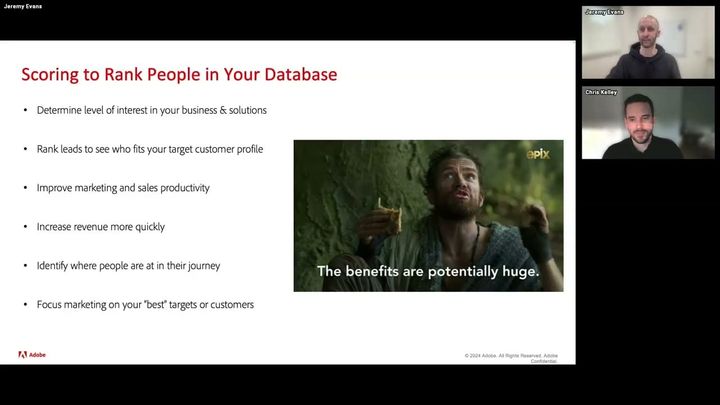
- The limitations of traditional lead scoring models, citing Gartner data that… (22:09)
- Intentional duplicate records impacting lead scoring, recommending against… (55:24)
Summarised from Adobe Marketo Engage User Groups · 1:01:48. All credit belongs to the original creators. Streamed.News summarises publicly available video content.